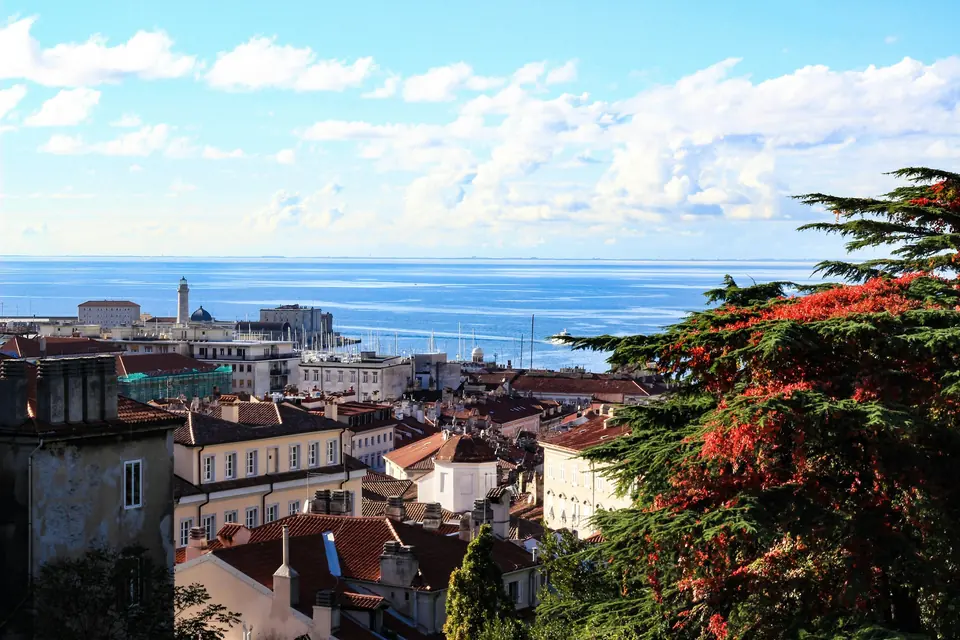
Day trips from Trieste: what to see nearby
In short
Most of the best day trips from Trieste are within an hour’s drive. For half a day, try Muggia (by ferry from the centre), Grotta Gigante, or Duino and the Rilke Trail; for a full day, Aquileia with Grado or, across the border in Slovenia, Piran or the Škocjan Caves. A car gives you more freedom, but Muggia, Duino, Sistiana and Aquileia are all reachable by boat, bus and train.
The best trips at a glance
Trieste sits in a corner of Italy where, in less than an hour, you can go from rocky coast to lagoon, from the Karst plateau to Slovenia. That makes the surrounding area surprisingly varied.
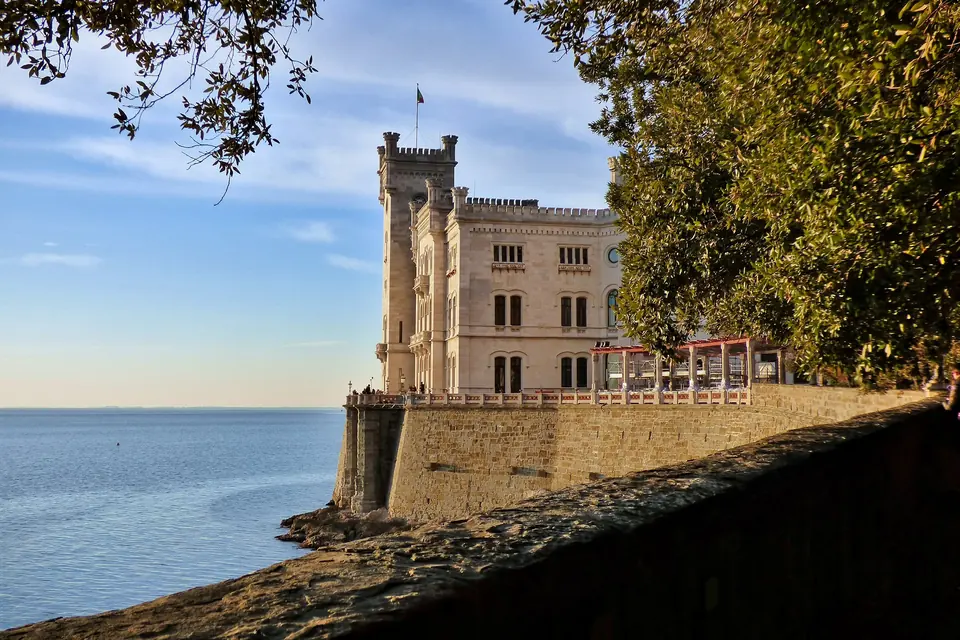
A simple rule for choosing: with half a day, stay close (Muggia, Duino and Sistiana, Grotta Gigante). With a full day, go further (Aquileia and Grado, Piran, Škocjan). Before leaving town, though, make sure you have seen Miramare Castle: technically it is still Trieste, but it already feels like a short excursion.
| Destination | Approx. distance | How to get there | Time to allow |
|---|---|---|---|
| Muggia | 12 km (by road) | Ferry from the centre, bus, car | 2–3 hours |
| Grotta Gigante | 15 km | Car, bus via Opicina | 2 hours |
| Sistiana | 20 km | Car, regional bus, boat in summer | Half a day |
| Duino Castle and the Rilke Trail | 25 km | Car, regional bus | Half a day |
| Škocjan Caves (Slovenia) | 30 km | Car | Half a day |
| Piran (Slovenia) | 40 km | Car, bus, boat in summer | A full day |
| Aquileia | 45 km | Car, train plus bus | Half a day |
| Grado | 55 km | Car, train plus bus | Half a day or more |
Distances and times are approximate, measured from central Trieste.
Along the coast to the north-west
Duino Castle and the Rilke Trail
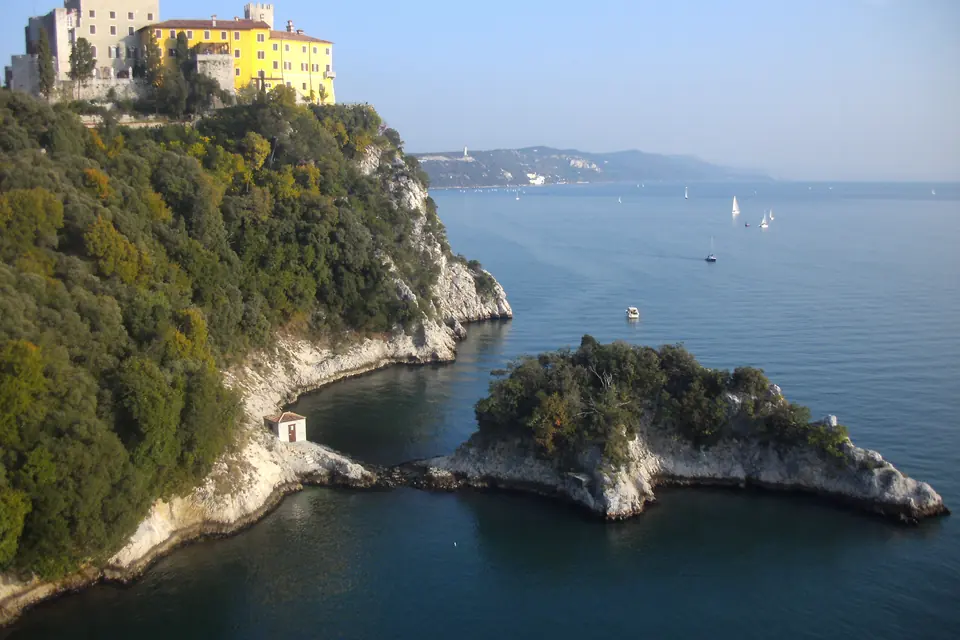
Duino Castle stands on a spur of white rock high above the sea, about 25 km from the centre. It still belongs to the della Torre e Tasso family (Thurn und Taxis) and part of it is open to visitors: rooms, terraces and gardens overlooking the gulf. Below, on another rock, you can see the ruins of the older castle.
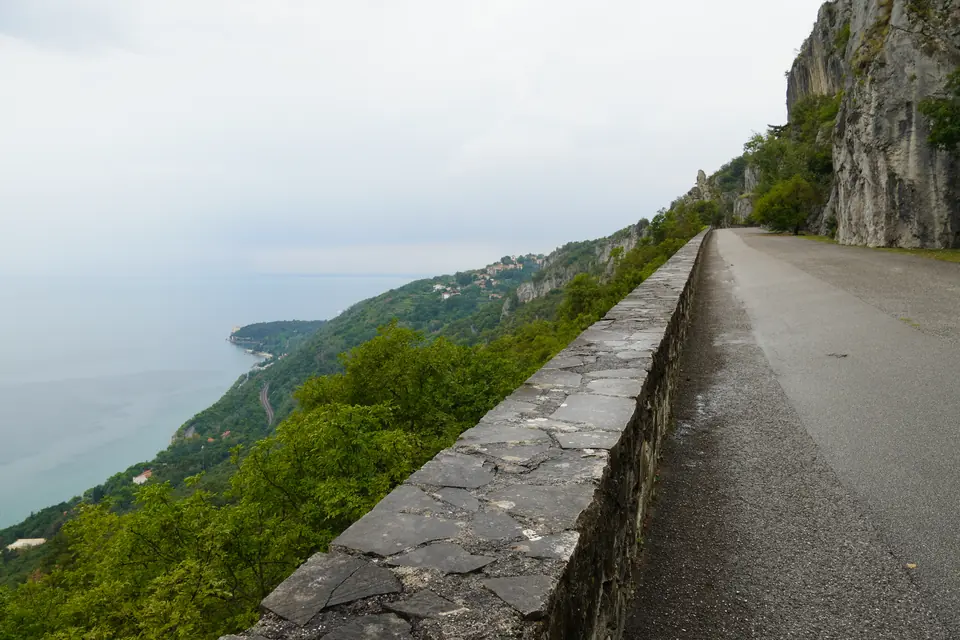
In the early 20th century the poet Rainer Maria Rilke stayed here as a guest and began writing the Duino Elegies. The Rilke Trail is named after him: an easy walk of just under 2 km between Duino and the bay of Sistiana, inside the Duino Cliffs nature reserve. The path follows the cliff edge through holm oaks and pines, with sea views all the way.
Getting there: by car along the Strada Costiera in about half an hour, or by the regional buses linking Trieste with Duino and Sistiana. Why go: it is the most dramatic stretch of coast on the gulf. Time: half a day for the castle and the trail.
Tip: walk the Rilke Trail from Duino towards Sistiana and finish with a swim. The castle’s opening times change with the season, so check the official website.
Sistiana
The bay of Sistiana, about 20 km away, is where the rocky coast opens into a sheltered inlet with shingle beaches and a small harbour. In summer it is Trieste’s busiest seaside spot after Barcola.
Getting there: by car or regional bus; in summer there are also seasonal boat services from Trieste, which vary from year to year. Why go: a swim and a sunset aperitivo, or as the end point of the Rilke Trail. Time: half a day. For a day that combines this coast with the plateau, see Trieste between sea and Karst.
Across the gulf: Muggia
Muggia is a small town of Venetian character on the far side of the gulf, directly opposite Trieste, where the Istrian peninsula begins. Its centre gathers around Piazza Marconi, with the cathedral and its Gothic façade, narrow lanes and a little harbour full of boats. Above the town, Muggia Vecchia has a Romanesque basilica and a fine view.
Getting there: the nicest way is the regular ferry that leaves from the waterfront near Piazza Unità d’Italia and crosses the gulf in about half an hour; check the current timetable before you go. Otherwise, bus or car, about 12 km. Why go: the view of Trieste from the water during the crossing is worth the trip on its own. Time: 2–3 hours.
On the Karst: Grotta Gigante
Fifteen kilometres from the centre, on the Karst plateau, Grotta Gigante is one of the largest show caves in the world, with a single chamber almost a hundred metres high. Visits are guided only, take about an hour and involve hundreds of steps down and back up; inside it is around 11°C.
Getting there: about 25 minutes by car, or by bus via Opicina (check routes and times). Why go: it is the most spectacular way to understand what “karst” actually means. Time: around 2 hours including travel, easy to combine with the Strada Napoleonica.
Towards Friuli: Aquileia and Grado
Aquileia
Aquileia, about 45 km away, was one of the most important cities of the Roman Empire and has been a UNESCO World Heritage Site since 1998. The highlight is the Patriarchal Basilica, with its huge 4th-century early Christian mosaic floor, one of the largest in Europe. Around it are the archaeological area with the forum, the Roman river port and the National Archaeological Museum.
Getting there: by car in about 45–50 minutes; by train to Cervignano-Aquileia-Grado station, then by bus. Why go: first-rate mosaics and Roman remains an hour from Trieste. Time: half a day.
Grado
Grado sits on an island in the lagoon, about 10 km south of Aquileia, linked to the mainland by a causeway road. The old town, known as Grado vecchia, is a tangle of lanes and small squares around the basilica of Sant’Eufemia; along the seafront are sandy beaches, quite different from Trieste’s rocky shore.
Getting there: by car or on the same bus from Cervignano; in some summers there is also a boat link from Trieste, worth checking. Why go: lagoon, beach and a compact historic centre. Time: half a day; combined with Aquileia it makes a perfect full day.
Across the border: Slovenia
Piran
Piran, on the Slovenian coast about 40 km away, is a Venetian-style town on a narrow peninsula. Its main square, Tartini Square, is named after the violinist and composer born here; above the rooftops rises the church of St George and its bell tower. Italian and Slovene are both official languages.
Getting there: about 50 minutes by car; there are also international buses and, in summer, boat links from Trieste worth checking. The centre is closed to traffic: you park outside and continue on foot or by shuttle. Why go: it is one of the loveliest seaside towns in the northern Adriatic. Time: a full day, perhaps with a stop in Koper.
Tip: Slovenian motorways require an electronic vignette. If your route uses them, buy it before you set off; otherwise look into the ordinary roads.
Škocjan Caves
The Škocjan Caves, about 30 km from Trieste, have been a UNESCO World Heritage Site since 1986. The Reka river flows underground through an immensely deep canyon, which the tour crosses on a bridge high above the water. It is unlike any other show cave you are likely to have seen.
Getting there: by car in about 35–40 minutes; public transport is more complicated, so check connections via Divača. Why go: the sheer scale of the canyon and the roar of the river. Time: half a day; the guided tour takes about two hours and involves plenty of steps.
Documents for Slovenia
Italy and Slovenia are both in the Schengen Area, so there are normally no systematic border checks. Still, always carry a valid passport or national ID card: temporary checks are sometimes reintroduced. If you are travelling from outside the EU, check the rules that apply to you.
Planning your trips
For train trips, Trieste Centrale station is a short walk from the Borgo Teresiano and the Grand Canal, and the rooms at Casa Bora are about 8 minutes away on foot, which makes early starts and late returns easy. With a long weekend, you could spend one day in the city using Trieste in a weekend and one day exploring the surroundings.
For the best places to look out over the gulf before or after your trip, see our guide to sea views in Trieste.
Frequently asked questions
What is the easiest day trip from Trieste without a car?
Muggia: the regular ferry leaves from the waterfront near Piazza Unità d’Italia and crosses the gulf in about half an hour. Check the current timetable before you go.
How long is the Rilke Trail?
Just under 2 km between Duino and the bay of Sistiana, on an easy path along the cliffs. Allow about 45 minutes one way at a relaxed pace.
Can you see Aquileia and Grado on the same day?
Yes, they are only about 10 km apart. A morning in Aquileia for the basilica and excavations, then an afternoon in Grado’s old town and seafront, is a classic combination.
Do I need documents to visit Slovenia from Trieste?
Slovenia is in the Schengen Area and there are usually no systematic checks, but you must always carry a valid passport or national ID card. Temporary checks can be reintroduced.
Škocjan Caves or Grotta Gigante?
They are very different: Grotta Gigante is a single enormous chamber close to the city, while Škocjan is an underground river canyon, further away and with a longer tour. If you are short on time pick the first; with a free half day and a car, the second.
Information is indicative: opening times, prices and services may change, so always check the official websites before your visit.